Showing posts with label discussion. Show all posts

Thursday, August 16, 2012

Writers: Mac or PC?

From Goodreads
So I was on Goodreads just now, when I spotted this photo of J.K. Rowling with the caption "J.K. Rowling at her laptop", holding what is clearly a white Sony VAIO (aka a PC). I mentioned this to a friend, and he immediately commented that "that is rare; nearly every writer uses a Mac these days." 

Now, I'm wondering how valid of a claim this is. So let's have a poll. Chime in, writers, aspiring writers, agents, publishers, bloggers - anyone in the book industry - what do you use, Mac or PC?

Friday, July 27, 2012

Go-To Books

There are a few books/authors whose work I tend to find myself drawn back to, time and again. Books that I'll re-read (although rarely from cover to cover again, mind you), flipping open to any page or to a particularly memorable scene. Sometimes just for fun, sometimes when I'm bored, sometimes when I need a bit of comfort. Does anyone else do that, re-read segments of books?

Off the top of my head, some that are among the more frequently revisited: the Harry Potter series, the Sisterhood of the Traveling Pants series, Crimson Hero, Little Women, The Hunger Games series... 

The photo above was taken earlier this summer at a hostel in London, England. There was a book exchange bookshelf in the lobby, and it was kind of cool to see all the well-traveled books there, left behind by unknown travelers. Browsed through Catching Fire as I charged my phone for a bit - it was a bit surreal, to be engrossed in a familiar book with a very different packaging. 

How about you, what're your go-to reads whose worlds you visit again and again?

Monday, June 6, 2011

Why YA? Why not?

Recently, the prestige and caliber of modern day YA has once again been cast in spotlights. Although it's been a recurring debate as of late, this Wall Street Journal articles has further thrown fuel on the fire. Numerous blog posts and twitter hashtags resulted (notably, #YAsaves & #YAkills). Now, a ton of great stuff has been said - the majority of it supportive of YA - so I'm not going to rehash that too much. I would, however, like to further propose a few points for discussion (and really, feel free to pop your opinions down below as comments).

First off, the age bracket of YA. The general acceptance seems to be the 14-18 range, solidly, although usually the span is greater, ranging from 12-20. Now, let's take note of the fact that this is indeed a wide range of ages, especially since it encompasses the onset of puberty and the transition into "adulthood". But let's also keep in mind the fact that everybody develops at a different rate, age is just a number, yada yada. As cliche as it may sound, it is also undeniably true that yes, a lot of 12-year-olds haven't had the same life experience as someone who's say, 30. But it is also likewise true that there are countless 16-year-olds out there with a much greater amount of maturity in their possession as someone who's say, 40. Furthermore, young adults aren't the only ones reading YA. Older adults aren't the only ones writing YA. And really, any decently written, worthwhile book should be able to transcend the superficial labels of age anyway.

The article by Meghan Cox Gurdon has already been hotly debated with numerous examples of how #YAsaves and counterexamples of dark fiction published in previous generations. To quote, "How dark is contemporary fiction for teens? Darker than when you were a child, my dear:" And then she proceeds to provide the example of The Marbury Lens by Andrew Smith. Now, correct me if I'm wrong, but The Marbury Lens is not contemporary YA. Let's compare apples with apples and oranges with oranges, shall we? If we look at John Wyndham's The Chrysalids or Ayn Rand's Anthem, fiction that contains sci-fi or dystopian or fantasy or paranormal elements in general tend to be darker than straight-up contemporary. YA contemporary of which there is an abundance of light-hearted, fun, easy-going reads, regardless, in addition to those that deal with the heavier material.

There seems to be a fair amount of First World naiveity going on here as well. When we look at the rest of the world, the brutality, the mutilation, the terror, the torture, the horrors of daily life... Things far worse than what's depicted in today's YA literature exists out there, occurs out there, and will continue to occur out there if it's ignored. Considering that the 'young adults' of today are the leaders of tomorrow, isn't it of absolute importance that these youth are exposed to the realities of the world so that we, homo sapiens, as a collective species, are able to acknowledge our flaws and our brutality so that we are able to take steps to ameliorate and eradicate said negativity?

Do we really want to spawn a generation whose biggest concern is whether the whale appears on Twitter, a generation who rages at being unable to access Facebook at school, a generation who dwells in ignorance of the atrocities that occur in the world? Let's take a famous example here, Harry Potter. Now, isn't it a valid point that Lord Voldemort, the Horcruxes, separating his soul through homicide, etc. etc. is comparably "dark" to those themes mentioned in Gurdon's article? And yet... we haven't seen anything on the news lately about any young adults attempting to split their soul through murder - shocker!

Judy Blume has published books as recently as 2008 - three years ago. Pretty sure that was the same generation as this current one, which would make... Judy Blume the Judy Blume of our generation, yeah?

And onto Katie Roiphe's article - in the Wall Street Journal Business section, no less - from two years ago today. The insult parade gets a head start with the title: "It Was, Like, All Dark and Stormy". Well, if that isn't a huge generalization about supposed "teen-speak". But most importantly, in the 'Corrections & Amplifications' section, the writer herself acknowledges: "Also, in the novel "Hunger Games," one teenager of each sex from each district competes in a competition to the death. Previously, the essay incorrectly said one teenager from each district competed." First off, the title of the book is The Hunger Games. Secondly, considering that the fact that both Peeta & Katniss are from the same district is such a key aspect of the novel - and the double tributes are such a dominant motif throughout - it would've been picked up by even a scanner-reader. Which begs the question, did Ms. Roiphe even read the novel before making judgements and trying to incorporate it as evidence?

Wall Street Journal, I can't say I'm not a little disappointed. Once, fine, maybe it was one article gone awry. But twice? And practically on the two year anniversary of the first? Really, really?

Maybe it's time to take a page out of npr's book on this topic.

What're your thoughts on this whole issue?

Monday, October 18, 2010

Upcoming CSN Review

We all know that online shopping is basically explosive in popularity these days. One amazing, super-comprehensive store is CSN Stores - they honestly have just about everything.

From gorgeous nightstands to beautiful lamps to sturdy bookshelves, CSN's series of stores has got you covered.

Those of you who've been visiting Lucid Conspiracy for awhile might remember a contest hosted in conjunction with CSN Stores back in June where a giftcard was given away. This time around, the lovely people over there have offered me the opportunity to review an article from one of their stores.

Living in a university dorm room, there's definitely a lot of stuff that would come in handy. At this point, I'm trying to decide between a desk chair, a mini fridge, or a portable space heater. Any opinions? Either way, definitely be on the lookout for a review coming soon!

In the meantime, pop by CSN Stores and check out their amazing selection of just about everything - furniture, shoes, bags, etc!

Monday, August 30, 2010

The Many Faces of The Hunger Games

It's always fascinating to compare international covers for books, see what persona they're taking on around the globe. Sure, there's that old saying, "don't judge a book by its cover" - but oftentimes, a book's cover can say a lot about its contents. This isn't a complete collection of all the international covers, but they're ones that I find of particular note.
These are the German covers for The Hunger Games and Catching Fire, respectively. There's no denying that both covers are very striking, very gorgeous. Beautiful colour schemes, and the covers themselves just sort of pop. I also like how only half the face is shown, and the eye just sort of stares at you. It's also kind of cool how "Panem" is the word of main focus on both covers.
These are the Taiwanese covers for The Hunger Games and Catching Fire, respectively. They both have the signature mockingjay on the cover, one in gold, one in bronze. Personally I think the cover for THG kind of looks like a movie poster. The atmosphere created is definitely chilling. Really like the colour scheme of CF, and how some of the main tribulations of the arena are depicted here.
Both of these are from the UK, and both are of The Hunger Games - but one is a girl version, and one is a boy version. I don't tihnk I've seen anything like this before, one book marketed simultaneously to different gender groups by having different covers. It's kind of a cool idea, really. The guy one has a Stephen King blurb, the gal one Stephenie Meyer. Hmm...
These are both of The Hunger Games as well, the Swedish on the left and the Danish on the right. The image on the Swedish cover is definitely very chilling, but I'm not particularly fond of the way the text was integrated. Love the title font on the Danish cover. The image itself seems to be marketed almost towards a younger audience though...
Again, both are of The Hunger Games, the Russian one is one left, and on the right is the cover from the Netherlands. For the Russian one, the characters aren't really how I would picture them. For one thing, they look older than they should. For another - and wait for the explanation before getting indignant - I would expect Katniss to be portrayed as thinner. If that's Gale in the background, likewise. If that's Peeta... well. Anyway - why? Despite being able to hunt, Katniss is from the Seam, and it's referenced throughout numerous times that food is not plentiful. Sure, she's able to get game. But it's still only enough to fill her stomach, not enough to eat in excess. That, plus the fact that she's always expending a large amount of energy, one would expect her to be a little more malnourished-looking. Walking around looking like she's getting a full three meals a day and then some would probably arouse a fair amount more suspicion than safe, considering the physical state of the other people around her. Really like the blue gradient on the Danish version of the cover.

How about you guys, any particular covers you like more than the others? What do you think of these ones?

Monday, August 23, 2010

Behemoth Books

So I've been noticing what seems to be turning into a trend in YA lit these days: long books.

Is it just me, or does it feel like there are more and more 400-page-plus books coming out recently? Some examples that come to mind off the top of my head would be Beautiful Creatures, Before I Fall, The Eternal Ones, Nightshade, etc. There are also a few in the 350-400 page range that are also rather hefty, such as The Dark Divine, Brightly Woven, etc.

Now, one of the general unspoken tidbits about writing is that there's no set word count - write it in as many or as few words as it takes to tell the story.

There are books that do this brilliantly. For example, The Hunger Games and Catching Fire (hehe, had to bring it up -Mockingjay tomorrow!) are decently sized books - but every page, every word feels necessary. The plot, the language, the characters - everything keeps the reader completely entranced. The Harry Potter books got pretty hefty by the end, but they're still amazing reads and hugely popular.

Unfortunately this doesn't always seem to be the case. Honestly, it feels like a recurring observation in many of my reviews now, the fact that some books are simply unncessarily long. I'm not going to into naming specific examples and calling anybody out here, but some scenes just feel like the book could've done without. Others, backstory and setting up the scene takes the first hundred pages or so. Seriously? Just get to the story already.

Has anyone else been finding this recently, books being longer than they need to be?

Sunday, July 18, 2010

What's Your Font?

I'm curious - how do you guys feel about fonts?

For me, there're specific fonts that I've simply come to associate with certain books or franchises. I'm sure the obvious ones come to mind for you guys as well - Harry Potter, the Twilight series, etc. all have very distinctive ones.

A little more subtle, the interior text of books often have unique fonts as well. Those favoured series that are often read seem to convey a certain personality through their specific respective fonts, each rounded loop, each serifed stem, each sloping line.

Unfortunately I don't know the fonts of these books off-hand (perhaps you do?), but there are a few that stick out particularly. Gail Carson Levine's fractured fairy tale books always seem to contain the same font, and I've come to have a fond spot for the innocent yet regal letters. Ann Brashares' The Sisterhood of the Traveling Pants series has one specific typeset throughout the novels, another one for opening chapter quotes, and then each Tibby, Bridget, Lena and Carmen have associated "handwriting"s. And correct me if I'm wrong, but I think Jaclyn Moriarty's characters (especially in The Year of Secret Assignments) have different writing as well.

Awhile ago I remember opening an MG book and literally thinking, "Oh my gosh, wow, it's Sisterhood of the Traveling Pants - font!"

How about you, do fonts play a role in your reading experience? Do you find yourself attached to a few in particular, or associate them with where you first saw them? What's your font?!

Thursday, April 29, 2010

Names: One & the Same

"What's in a name? that which we call a rose | by any other name would smell as sweet." - William Shakespeare, Romeo and Juliet
Character names. Undoubtedly integral aspects of stories, no? Coming up with names can be a pesky business. Sometimes it feels like there are no suitable options; other times like there's an endless sea of possibilities and it's impossible to decide.

But there a few names that I've always sort of connotatively thought of as vetoed - forbidden. The first one, of course, being the [writer]'s own name. From the writing perspective, I've never really been able to bring myself to use my own name for any of my characters. On some level, it just feels a little strange to me, because I think I would find that uncomfortable. And I've always marveled at novels with characters which take the names of their creators.

Recently, I noticed that there's a Lauren in Before I Fall, by Lauren Oliver. Another classic example would be Jane Bennet from Jane Austen's Pride and Prejudice. Now, I found this one to be particularly striking. Jane Bennet is characterized as the most beautiful, the kindest, etc. Jane and Jane - is that representative on some level?

When it comes to reading, how does it feel to encounter a character with the same name as you? (I happen to have a fairly uncommon name, so it doesn't really happen to me.) What about people you know, is it strange reading about characters with the same name as them? Recently read Kristin Walker's A Match Made in High School, and one of the characters not only had the same name, but a few similar character traits, and a similar hobby as someone I happen to know. It was definitely interesting, and a little hard to distinctly differentiate the two.

I've also been hearing from some people about how they feel uncomfortable naming characters with the same name as people they know (provided that the two aren't meant to be linked/named after). I'm personally like that too. How about you?

I guess now I'll open the topic up to discussion. So, some leading questions to get it started:

How do you feel (from a reader's or writer's perspective) about characters with the same name as the author? With your name? With the names of people you know?

Friday, May 1, 2009

Readers as Writers, & vice versa

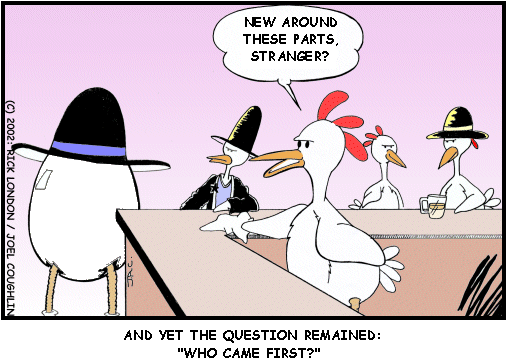
What came first, the writer or the reader?

After conducting a couple interviews, it would appear that there is a general consensus in terms of advice for aspiring writers: read. So of course it comes as no surprise that most of us who write also love to read.

But does that also hold true inversely? Just out of curiousity, how many of you book bloggers out there also write (prose, poetry, song lyrics, journalism, diary entries, etc. anything at all)?

I've also been wondering (and the fact that I'm currently in the midst of The Chosen One, by Carol Lynch Williams, may or may not have anything to do with it) some other questions, especially since a few days ago, a spam filter question on a contest asked something along the lines of if you could only choose one, who you rather have writing or reading?

I'd originally had a couple other concepts up for discussion, but alas, SAT cramming seems to really fry the brain. ;) It would be great to see what other people think of this.

Just to sum up, for those skimming, and feel free to interpret them however you like:

~Writers, do you all read?
~Readers, do you write as well?
~If you could only have one, reading or writing, which would it be/why?
~Anything else you'd like to add ;)

Thursday, April 2, 2009

Tense

Past vs. Present

When it comes to tense in YA literature, do you have a preference between past or present tense?

It seems that there is a greater range of popular books out there that are written in present tense. Recent ones that come to mind include Wake, Fade, The Hunger Games, etc. to name a few.

Now, traditionally I've been more of a reader of books written in past tense. (Heck, there was a time when I wouldn't even be able to read past the first chapter in present tense!) I think the first (most memorable) book/series I read written in present tense was Libba Bray's The Sweet Far Thing.

And now, I'm actually quite comfortable with it. In fact, I'm even considering employing the present tense for my next WIP (yes, The Kevlar Moustache has been, for all intents and purposes at the moment, completed).

Is this an actual trend towards this direction in the YA publishing industry, or just something I hadn't really picked up on before? Because it seems like these books are doing well nowadays.

So, what are your thoughts on this issue, do you have a preference for one over the other? Do you think the market is naturally transitioning in this direction? Are there specific pros and cons between the two?
Related Posts Plugin for WordPress, Blogger...